Many platforms help customers manage critical parts of their business. They handle scheduling, customer communications, reporting, billing, and countless other workflows.
But when it’s time to pay workers, many platforms still ask customers to leave the platform and run payroll somewhere else. That’s a problem because payroll isn’t a separate workflow. It’s the operational conclusion of everything that happened before it.
A worker completes onboarding paperwork, passes an I-9 verification, enrolls in benefits, gets scheduled, works a shift, and records time. Payroll is what turns all of those activities into compensation. Yet for many businesses, payroll still lives outside the system where the work actually happens.
For years, that made sense. Payroll was difficult to build, expensive to operate, and often easier to outsource to a third party. Today, that is beginning to change.
Advances in payroll infrastructure, APIs, and AI are making it easier for software platforms to bring payroll into the products their customers already use every day.
When payroll becomes part of the platform experience, customers spend less time managing disconnected systems and more time running their business. Only then do the business benefits emerge: stronger retention, new revenue opportunities, and a larger role in the customer’s operations.
Where Embedded Payroll Creates the Most Value
Embedded payroll creates value in a few different ways, but the biggest opportunity is often revenue expansion and customer retention.
Payroll is one of the largest and most recurring expenses a business has. When companies bring payroll into their product, they can capture a larger share of customer spend while making their platform more central to day-to-day operations.
The result is a stronger product, additional revenue, and customers who are less likely to leave because payroll becomes deeply integrated into how they run their business.
Where payroll lives today
A gym runs nearly everything in PropelOS — then leaves to run payroll
lockOn platform
fitness_center
Gym owner
Summit Fitness — runs the whole business in one place
PropelOS provides software that helps gyms run nearly every aspect of their business — scheduling, memberships, payments, and marketing. But payroll still happens somewhere else, on a separate provider the owner has to log into, export hours to, and reconcile by hand.
PropelOS is a fictional brand created for illustrative purposes only. It does not represent a real company, and any resemblance to an actual business is coincidental.
Instead of referring customers to a third-party payroll provider, platforms can offer payroll directly within the experience they already own. That creates three meaningful advantages.
First, it creates a new recurring revenue stream from a service customers already have budget for. Second, it increases average revenue per customer by expanding the number of workflows managed within the platform.
Third, it strengthens retention. Payroll is one of the most operationally critical systems a business uses. When payroll becomes part of the platform experience, the relationship often becomes significantly more durable.
The strongest embedded payroll opportunities tend to occur when payroll aligns naturally with the value a platform already delivers. If customers already rely on your platform to help run their business, payroll often becomes a logical extension of that relationship.
The Business Case for Embedded Payroll
Most software companies already understand how to monetize the workflows they own.
Scheduling software adapts for scheduling. Payments platforms monetize payments. Payroll follows the same pattern.
PropelOS payroll revenue model
What could payroll be worth?
A hypothetical example using PropelOS.
Assumptions
Gyms on platform500
Avg. employees per gym120
Total workers60,000
Payroll fee (PEPM)$12
PEPM = per employee, per month — the standard way embedded payroll is priced.
The math
60,000workers (500 × 120)
×$12PEPM
×12months
Estimated annual revenue
$8.64M
trending_upper year
info
This assumes payroll revenue only — no instant pay, benefits, retirement, or other financial products.
And payroll is only the entry point
Each layer of embedded finance compounds on the worker relationship payroll establishes.
paidPayroll
$8.64M
Live today
arrow_forward
bolt
Instant Pay
Next
arrow_forward
health_and_safety
Benefits
Future
arrow_forward
savings
Retirement
Future
arrow_forward
account_balance
Other financial services
Future
Illustrative figures only. PropelOS is a fictional brand created for illustrative purposes and does not represent a real company.
Consider PropelOS, a platform that helps local gyms manage scheduling, memberships, payments, and daily operations. Every one of its customers already runs payroll, typically through a separate provider. Embedded payroll doesn’t create a new need. It allows PropelOS to participate in a workflow its customers would otherwise buy elsewhere.
By embedding payroll directly into the platform experience, that spend becomes a new source of recurring revenue.
For example, if PropelOS serves 500 gyms with an average of 120 employees each, that’s approximately 60,000 workers being paid through the platform. At $12 per employee per month, payroll alone could represent more than $8.6 million in annual recurring revenue.
And that’s just the starting point. The opportunity extends beyond payroll software fees.
Once payroll becomes part of the platform, additional products become easier to offer. Faster payments, paycards, retirement products, benefits administration, payroll financing and other financial services can all build on the payroll relationship.
The result is not simply another product line, it’s a foundation for expanding revenue across the broader employee lifecycle.
Operational Complexity Has Been the Limitation…Until Now
If the revenue opportunity is so attractive, why haven’t more platforms embedded payroll already? The answer is simple: payroll is operationally complex.
Payroll requires calculating gross-to-net, new hire reporting, tax filings, compliance monitoring, payment processing, support operations, exception handling, year-end reporting, and countless edge cases that emerge when real businesses employ real people.
Historically, that migration often required exporting employee records, payroll history, tax settings, and direct deposit information. Teams would spend days or weeks cleaning spreadsheets, mapping fields, validating data, and resolving discrepancies before the first payroll run could happen.
Or consider a yoga instructor whose direct deposit fails. The worker contacts the gym HR, but they don’t know what has happened. So they contact PropelOS, and they have more details but aren’t payments experts. PropelOS contacts their embedded payroll provider who investigates the issue. The workers’ bank account information needs to be verified. The payment needs to be reissued. What appears to be a simple problem quickly turns into an operational workflow involving multiple systems and multiple people.
Now multiply those scenarios across hundreds of customers and thousands of workers. The challenge has never been recognizing the value of payroll. The challenge has been operating payroll at scale.
AI Changes the Economics
AI isn’t making payroll less complex. It’s reducing the amount of human effort required to manage that complexity.
AI’s impact on payroll is often discussed in terms of automation, but the more important shift may be operational leverage.
Areas that historically required large operations, support, implementation, and compliance teams can increasingly be handled through software:
Migrations — Payroll migrations that once took weeks can increasingly be accelerated through AI-assisted extraction, mapping, validation, and configuration.
Payroll Operations — Payroll runs that required manual review can increasingly be monitored by systems that identify missing data, unusual earnings patterns, tax issues, and other exceptions before payroll is processed.
Worker Support — Questions about paychecks, tax forms, deductions, and payment status can increasingly be resolved by systems that understand payroll records and transaction history.
Compliance — Issues that were historically discovered after payroll runs can increasingly be surfaced before they become errors, reducing remediation work and compliance risk.
Exception Management — Garnishments, tax notices, returned payments, missing banking information, and other edge cases can increasingly be identified, routed, and resolved with less human intervention.
Reporting & Insights — Reports that once required analysts or support teams can increasingly be generated on demand through natural language queries and automated analysis.
Payroll remains complex. What changes is the cost of operating it. And that changes the economics of embedded payroll.
The infrastructure shift
What AI is compressing
The operational work behind payroll isn't disappearing. Increasingly, it's being automated.
Illustrative only. PropelOS is a fictional brand created for illustrative purposes and does not represent a real company.
Data and Trust: The Inputs to Embedded Payroll
Not every software platform starts from the same position when it comes to payroll. Some already possess data that naturally feeds payroll.
Consider PropelOS. The platform already knows which instructors taught classes, which locations they worked at, how many hours they worked, and what they should be paid. Much of the information payroll needs already exists inside the platform before payroll is ever introduced.
For companies like this, payroll becomes a natural extension of workflows they already manage. But owning workforce data is not a requirement. The more important asset is often the customer relationship itself.
Businesses increasingly want fewer vendors, fewer systems, and fewer operational handoffs. They want the products they already trust to handle more of the workflows required to run their business. That’s why the embedded payroll opportunity extends well beyond workforce-focused platforms.
Financial platforms, business operating systems, industry-specific software providers, and other platforms that serve businesses are increasingly evaluating payroll as a natural extension of the value they already provide.
Some companies have an advantage because they already own payroll inputs. Others have an advantage because they already own customer trust. The strongest opportunities often have both.
The incumbent advantage
Data and trust: the inputs to embedded payroll
Two different kinds of advantage point toward the same product — payroll. But they are not equal.
PropelOS already knows
Operational data, captured every day the gym runs.
badgeTrainer / staff member
location_onGym location
scheduleHours worked
calendar_monthClass schedule
paidCommission earnings
arrow_downward
receipt_longPayroll
databaseA data head start — the inputs to a pay run already live on the platform.
hubOther software platforms already own
The relationship itself — not just the data.
handshakeCustomer relationship
credit_cardBilling relationship
insightsBusiness data
replayDaily workflow
arrow_downward
paidPayroll
verified_userA trust head start — the business already runs its money through them.
lightbulb
Workforce data helps. Customer trust matters more.
Illustrative only. PropelOS is a fictional brand created for illustrative purposes and does not represent a real company.
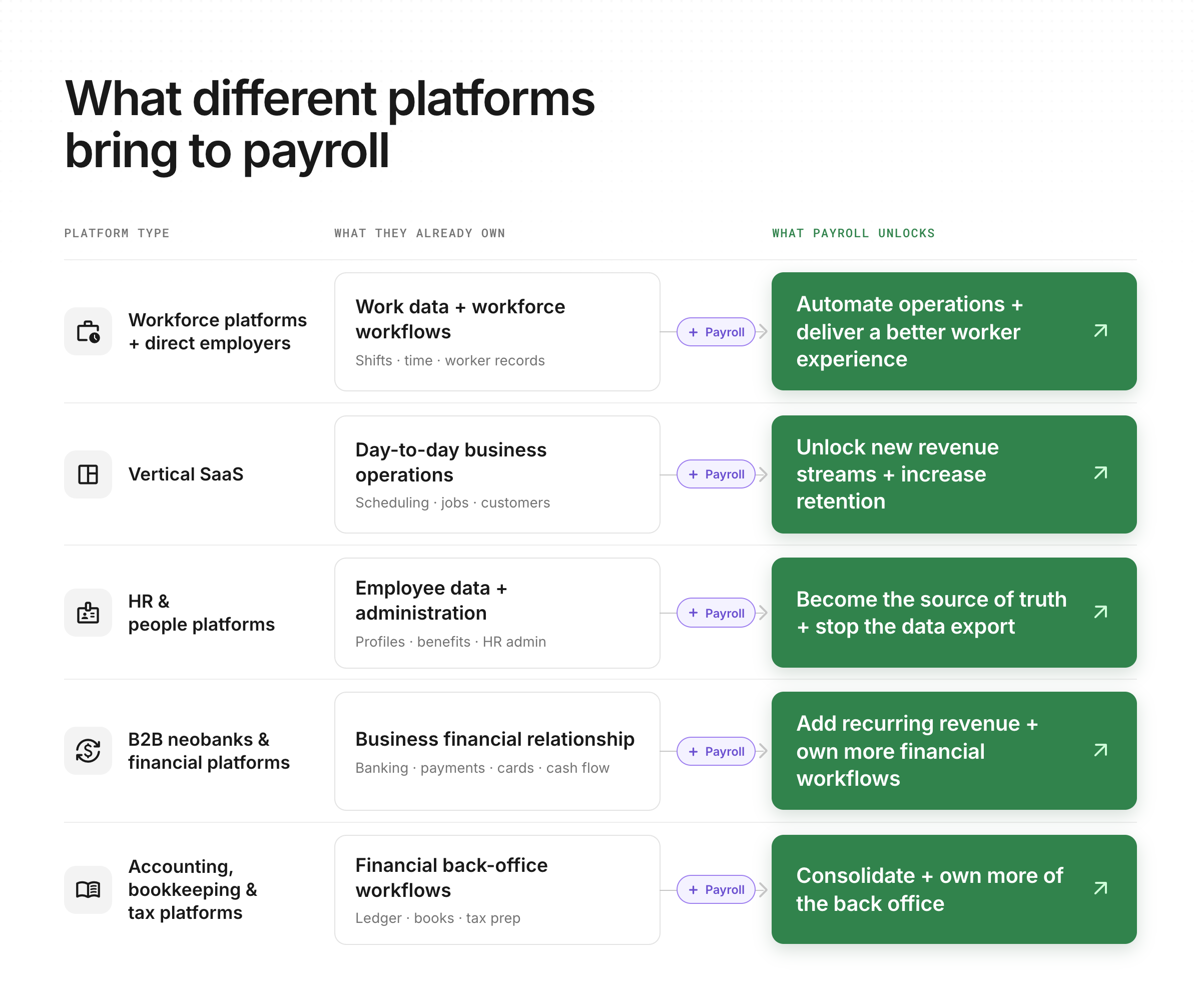
What Types of Platforms Are Embedding Payroll?
The Ones That Own the Work — Staffing platforms, gig marketplaces, direct employers, home healthcare platforms, and workforce management systems already know who worked, where they worked, and what they earned. Embedded payroll lets them automate their operations and turn that existing data into a better worker experience by not handing the workflow off to another system.
The Ones That Run the Business — Vertical SaaS and Business Operations platforms already help customers run the day-to-day operations of their business, from scheduling and billing to customer management. Payroll lets them bring another critical workflow into the same system, increasing customer retention and providing a new revenue stream.
The Ones That Know the Employee — HR and people platforms already manage employee records, onboarding, benefits, and other workforce administration. Payroll connects that employee data to compensation, allowing more of the employee lifecycle to happen in one place so customers stop exporting data to other tools and make them the source of truth. This provides them the opportunity to make their platform a better suite of products and make more money.
The Ones That Manage the Money - Business neobanks and financial platforms already help businesses manage banking, payments, cards, or cash flow. Payroll gives them another major recurring financial workflow to bring into their product, creating a new source of recurring revenue while expanding the financial relationship they already have with customers.
The Ones That Want to Own the Back Office — Accounting, bookkeeping, tax, and business management platforms already manage critical financial and administrative workflows. Adding payroll helps them consolidate more of the back office in one place and monetize more of how customers operate their businesses.
The starting point may be different, but the opportunity is similar. The platforms best positioned to embed payroll already own an important part of the relationship, whether that’s the work, the employee, the business workflow, the back office, or the movement of money. The question then becomes what infrastructure they need to turn that advantage into a payroll product.
AI’s Necessary Prerequisite: Infrastructure
For years, payroll systems were systems of record. They stored employee information, calculated wages, generated tax documents, and maintained compliance records. The system held the information, the humans did the work.
Payroll teams investigated failed payments. Support teams answered workers questions. Operations teams ran payroll every two weeks. Compliance teams monitored changing regulations. AI is beginning to change that model. What were once siloed processes are increasingly becoming connected workflows software can monitor, coordinate, and execute.
But that only works when AI can access the systems where the work actually happens. An AI agent doesn’t create value simply because it can answer questions. It creates value when it can access payroll data, understand the context of a situation, and take the actions required to move a workflow forward.
If employee records live in one system, payroll data lives in another, compliance workflows live somewhere else, and payments are managed by a collection of third-party vendors, AI becomes limited. It might be able to explain problems, but it can’t resolve them.
When data, workflows, and operational systems are connected through a common infrastructure, AI can do much more. It can identify issues, gather missing information, coordinate actions across systems, and increasingly complete work without requiring human intervention.
Consider a few workflows inside PropelOS:
New Customer Onboarding
A gym decides to switch payroll providers. Historically, someone would ensure a manual process to export the data from the previous provider, clean up spreadsheets, map fields, validate records, and configure payroll settings.
With the appropriate access to the underlying systems, AI can extract historical data, recognize how fields should be mapped, identify discrepancies, flag missing information, and validate records before they become payroll errors downstream.
The result is a better, less error-prone migration experience and an underlying workflow in which the economics of offering payroll are fundamentally changed. What once required weeks of manual effort and multiple operational teams can be done in hours with significantly less human intervention.
New customer onboarding
A gym switches payroll providers — and AI runs the migration
With access to the previous provider's data, AI extracts records, maps fields, flags discrepancies, and validates everything before it can become a payroll error — turning weeks of manual work across multiple teams into hours.
app.propelos.com/payroll/migrate
Payrollchevron_rightSet upchevron_rightMigrate from previous provider
●Step 3 of 4 · Review
Importing from ADP
AI is migrating 118 employees, 18 months of pay history, and tax setup.
AI extractarrow_forwardAI maparrow_forwardAI validatearrow_forwardApprove & import
Illustrative mockup. PropelOS is a fictional brand created for illustrative purposes; payroll surface shown powered by Zeal embedded payroll.
New Instructor Onboarding
A gym hires a new instructor. The instructor needs to complete tax forms, verify their identity, provide banking information, and become payroll ready.
Instead of waiting for a payroll administrator to identify missing information and follow up manually, AI can monitor the workflow, request documents, validate records, and move the onboarding process forward automatically.
Compliance Monitoring
A gym expands its operations to Colorado after operating exclusively in Texas which triggers a chain of payroll and compliance requirements.
The business may need new state tax registrations, unemployment insurance accounts, updated withholding configurations, and labor law notices. Employees working across multiple states may create additional tax and reporting obligations.
Historically, these issues were often discovered after the fact. A payroll administrator notices a discrepancy. A tax notice arrives in the mail. A support ticket gets opened. Multiple teams become involved to investigate and correct the problem.
Increasingly, AI can help identify these issues before they become payroll errors. When payroll, worker records, tax data, and compliance systems operate on a common infrastructure, software can detect changes in business activity, recognize that new requirements may apply, surface potential risks, and guide customers toward the actions needed to remain compliant.
Multi-state expansion
A gym expands to Colorado — and AI catches the compliance work first
When payroll, worker records, tax data, and compliance run on one system, software can detect a change in business activity, recognize that new requirements apply, and guide the owner to act — before a discrepancy, a tax notice, or a support ticket ever appears.
app.propelos.com/payroll/compliance
Payrollchevron_rightCompliance
lanPayroll · Records · Tax · Compliance — one system
auto_awesome
New work location detected — ColoradoAI complianceAction needed
Your business activity shows workers now in Colorado. Operating in a new state triggers tax and labor requirements. AI has prepared the steps to keep Summit Fitness compliant — caught 11 days before your next pay run.
DismissboltStart setup
location_onTexas
check_circleRegistered
Home state · 116 employees · all filings current
location_onColorado
New
Denver · 4 employees · 4 requirements
Why AI flagged this
home_pinNew employee home address in Denver, CO
eventRecurring classes scheduled at Denver location
checklistWhat Colorado requires
AI prepared 3 of 4
receipt_long
State income tax withholding
Register with the CO Department of Revenue
auto_awesomeAI can file
account_balance
Unemployment insurance (SUI) account
CO Dept. of Labor — needs your signature
editAction needed
tune
Withholding configuration
CO rates applied to the 4 Denver employees
check_circleAI configured
description
Labor law notices & multi-state reporting
CO postings prepared · TX + CO reporting set
check_circleAI prepared
1 step left for you · ~5 minutesComplete SUI account →
Caught upstream
11 daysearly
Surfaced before the next pay run — not after a tax notice arrives.
verified_user0 payroll errors · 0 penalties
Reactive → proactive
Before — after the fact
errorDiscrepancy noticed in payroll
mailTax notice arrives in the mail
confirmation_numberSupport ticket · multiple teams
Now — before the error
check_circleAI detects the change
check_circleSurfaces the new requirements
check_circleGuides the owner to act
lan
Because payroll, worker records, tax data, and compliance share one infrastructure, a change in business activity becomes a signal — software recognizes new obligations and guides the owner before they turn into payroll errors.
Illustrative mockup. PropelOS is a fictional brand created for illustrative purposes; payroll surface shown powered by Zeal embedded payroll.
Running Payroll
It’s payroll day. A gym has new instructors who recently joined, existing employees with overtime hours, benefit deductions that need to be applied, and workers who may have performed services in multiple jurisdictions during the pay period.
Historically, payroll administrators review reports, investigate exceptions, validate time and earnings data, ensure new hire reporting requirements have been satisfied, confirm tax calculations, and resolve issues before payroll can be processed.
With the appropriate infrastructure in place, AI can monitor the entire payroll workflow. It can identify missing onboarding requirements, flag unusual earnings patterns, detect potential compliance issues, validate payroll inputs, and surface exceptions that require human review.
Rather than spending hours searching for problems, payroll teams can focus on reviewing a smaller set of issues that genuinely require judgment.
The result is not fully autonomous payroll, but a workflow where payroll runs become faster, more accurate, and significantly less dependent on manual administrative effort.
Where Zeal Fits
In the last two decades, software platforms have steadily expanded the services they offer customers. Payments moved from standalone providers to embedded solutions, banking followed, then identity verification.
In each case, platforms stopped sending customers elsewhere and began embedding workflows directly into the products they already offered. Payroll is beginning to follow the same pattern.
Offering payroll requires far more than a payroll engine. It requires infrastructure, compliance, operations, and ongoing maintenance that most software companies have no interest in building themselves.
That is where Zeal fits. We provide the infrastructure software platforms need to build payroll products directly into their own experience, allowing them to focus on customer workflows, product design, and distribution rather than payroll complexity.
For a company like PropelOS, payroll becomes a natural extension of the platform rather than a separate system customers have to leave to use. Studios can onboard employees, run payroll, access paystubs, manage tax documents, and pay workers from the same product they already rely on to run their business.
The result is a payroll experience that feels native to the platform, not bolted onto it.
Alyssa Cuda is a content strategist, creative copywriter, and brand storyteller based in Austin, Texas. With expertise in content development, executive communications, social media , and technical integrations, Alyssa blends data-driven strategy with compelling brand voice. Her byline has appeared in industry publications and companies such as WP Engine, where she’s written case studies, blog posts, and performance-driven content. A passionate “introvert with an opinion,” when she isn’t writing, Alyssa can be found swimming, exploring the outdoors, or enjoying time with her family.
school
Education
BA, Sociology, Trinity University
star
Expertise
FinTech, Content Marketing
There’s a better way to onboard, pay, and bill.
Upgrade your worker and admin experience. Optimize your workflows and your cash flows.
Zeal is a financial technology company, not an FDIC insured depository institution. Banking services provided by Bangor Savings Bank, Member FDIC. FDIC insurance coverage protects against the failure of an FDIC insured depository institution. Pass-through FDIC insurance coverage is subject to certain conditions.
Mastercard® Debit Card is issued by Bangor Savings Bank, Member FDIC, pursuant to license by Mastercard International Incorporated. Mastercard is a registered trademark, and the circle design is a trademark of Mastercard International Incorporated. Spend anywhere Mastercard is accepted.