Payroll is the most quintessential form of economic exchange. It’s the basic tradeoff between work done and value created. In the U.S. alone, employee compensation accounts for roughly 52–54% of national income and generates an estimated $1.5–$1.6 trillion in annual federal payroll tax revenue, according to the U.S. Bureau of Economic Analysis.
And yet, for something so central, payroll is almost invisible in conversations about innovation. For years, we’ve seen innovations in consumer and business payments but when it comes to paying workers, progress has been incremental at best.
Why does it feel like an industry that handles the lifeblood of business is so painfully behind?
Because payroll has an infrastructure problem. The outdated software you see is actually the surface layer of a deeper problem: batch-based systems that can’t operate in real-time, fragmented compliance logic, and disconnected workflows.
Instead of rebuilding that foundation, the industry adapted around it. Legacy vendors extended the same core systems, layering features on top, constraining “innovation” in payroll before it even started.
When the foundation is wrong, the system offloads its limitations to the users. The result is more manual work and processes, not innovation.
In this article, we’ll unpack why payroll hasn’t kept up with the modern workforce, how legacy infrastructure continues to hold companies back, and what it takes to rebuild payroll the right way.
Payroll was built for a world where employees work full-time, in one place, and for one company. It was built for a world of predictable pay, standard schedules, and slowly changing tax rules.
Today, companies operate across several states and jurisdictions. They manage blended workforces of W-2 employees and 1099 contractors. Workers move between roles, locations, and classifications preferring the flexibility of shift-based work. Compliance is more fragmented than ever spanning from employment eligibility verification all the way through to employee termination. There are over 11,000 state and local tax jurisdictions in the U.S. alone who collectively implement more than 25,000 policy changes per year. And workers prefer to be paid today, not in two weeks..
The workforce is only becoming more complex. Nearly 38% of workers in the U.S. already participate in freelance work, with projections nearing half of the workforce by 2028.
What traditional payroll systems were designed to treat as edge cases has become the norm. A worker crosses state lines and tax logic breaks. A company introduces a second worker classification with different workflow rules. A team wants to pay faster to help retain workers but is limited by batch processing requirements.
These aren’t exceptions, they are the default, day-to-day conditions of modern work. And yet, for the most part, payroll still runs as if nothing has changed.
Payroll is a necessity for every company and despite the lack of innovation companies continue to spend increasingly more on it. The global HR payroll software market is poised to expand from $35.26 billion in 2024 to $91.69 billion by 2034.
Over the past several decades, tens of billions of dollars have been invested into payroll and workforce infrastructure, spanning legacy software, outsourced services, and a new generation of cloud platforms backed by venture capital.
And yet, despite that level of investment, the core experience of running payroll has barely changed.
That’s because most payroll innovation today has happened within the constraints of legacy systems. What appears to be progress is often just surface-level improvement layered on top of infrastructure that was never rebuilt. Better integrations, faster rails, and sleeker interfaces don’t change the fact that the same underlying limitations remain.
The problem doesn’t stem from a lack of awareness. Instead, every force in the system reinforces the status quo creating a feedback loop that increases involution, profits off of retroactive fixes, and hardens legacy systems despite their ineffectiveness.
Incentives are misaligned. Legacy payroll vendors profit from complexity, not simplicity. More modules mean more revenue and more fragmentation means deeper lock-in. The false promise of the “all-in-one platform” increases dependency instead of efficiency.
Data is fragmented. There is no real-time source of truth. Payroll depends on disconnected systems across onboarding, time tracking, pay, and billing. Data is exported, transformed, and re-imported just to complete a single cycle. Accuracy relies on reconciliation, not design.
Technology debt is crippling. These systems are not only outdated, they are deeply entangled. Years of patches, jurisdictional logic, and edge-case handling sit on infrastructure that processes billions of dollars. Rewriting it introduces real risk: incorrect pay, tax errors, and compliance failures. So, as a result, systems are maintained, not rebuilt.
Culture resists change. Payroll operates under real constraints; if something breaks, workers don’t get paid or companies face fines. Too often, those constraints are used as a reason not to change. Legacy systems weren’t built to evolve within them, so progress stays slow and incremental instead of continuous and adaptive.
The problem gets deprioritized. Payroll is treated as solved. Vendors expand into adjacent areas (timekeeping, HR, recruiting, benefits) trying to own more of the workflow. Innovation shifts toward growing the platform, not improving payroll.
Payments are mistaken for payroll. Modern fintech approached payroll from the wrong starting point. Behemoths like Stripe built powerful systems for moving money, then tried to extend them into payroll. But payroll isn’t a payments problem. It’s a compliance and calculation problem that results in a payment. Movement is easy, accuracy is hard.
When we see payroll as infrastructure, we stop misunderstanding the consequences of its inadequacies. For businesses with a contingent, hourly, or shift-based workforce, inefficient payroll not only inhibits revenue, it introduces costly risk.
It is impossible to predict exactly how these constraints will play out across every company or industry, but the patterns are already clear:
Compliance risk becomes a constant threat. Payroll is no longer governed by a single set of rules. It is shaped by thousands of overlapping requirements across tax jurisdictions, wage laws, classification standards, and local regulations. A single mistake such as an incorrect withholding, a missed filing, or a misclassified worker can trigger audits, fines, and legal exposure. But the burden of this complexity is often pushed onto workers themselves. In many legacy systems, compliant onboarding takes days or weeks as workers move through fragmented systems, manual verification processes, and delayed approvals before they can start earning. Pay is slowed down for similar reasons, with legacy systems relying on rigid time approvals and manual reconciliation processes to ensure compliance before payroll can run.
Companies like Wonolo, Qwick, NurseIO, and Traba manage both W-2 employees and 1099 contractors across multiple jurisdictions, where compliance spans new hire reporting, tax withholding, I-9 verification, and ongoing filing requirements. In these environments, compliance cannot be a downstream check. It must be embedded directly into how workers are onboarded and paid.
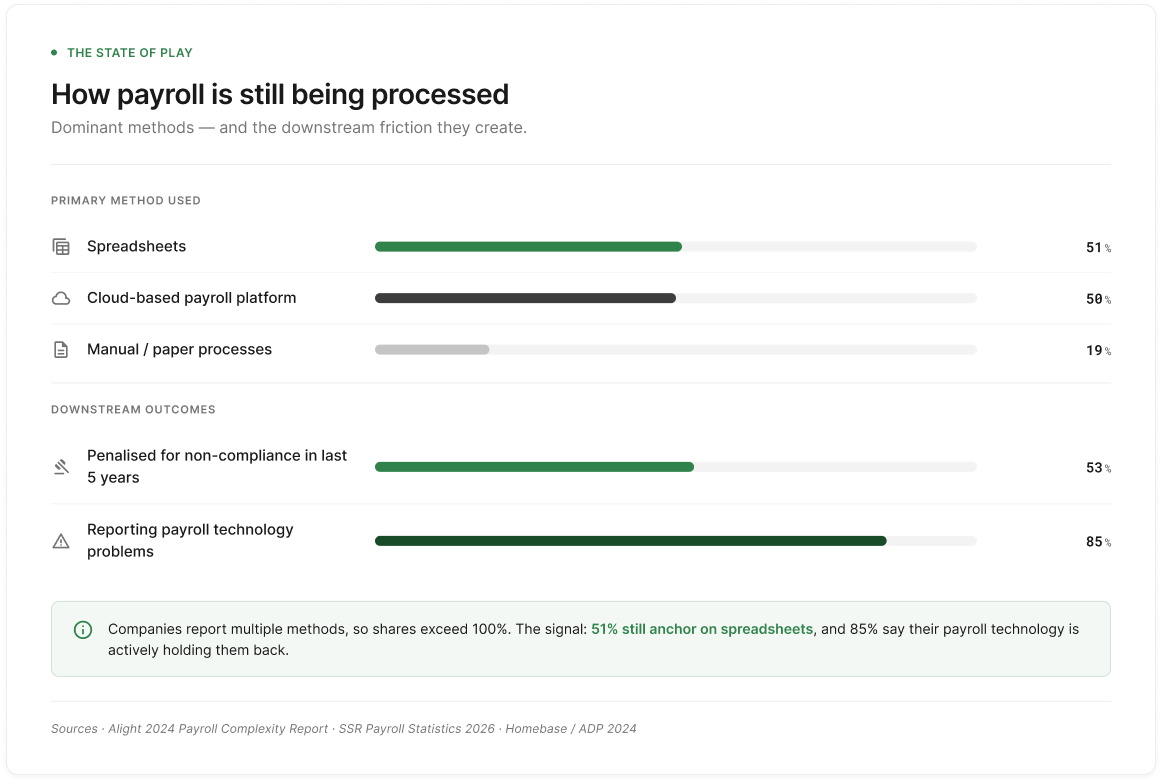
Only about 50% of companies use some form of digital payroll software. And even among those that do, most still rely on spreadsheets and other disconnected tools to complete payroll, stitching together data across disparate systems. While software has digitized much of the work, it has also redistributed it. It’s not surprising, then, that 85% of companies using payroll software still report issues, from errors and delays to compliance gaps.
The U.S. Department of Labor collected $318 million in back pay and penalties in fiscal year 2025, reflecting a significant increase from the prior year. Common compliance risks include employee misclassification, inaccurate wage reporting, failure to meet updated wage thresholds, and late payroll filings.
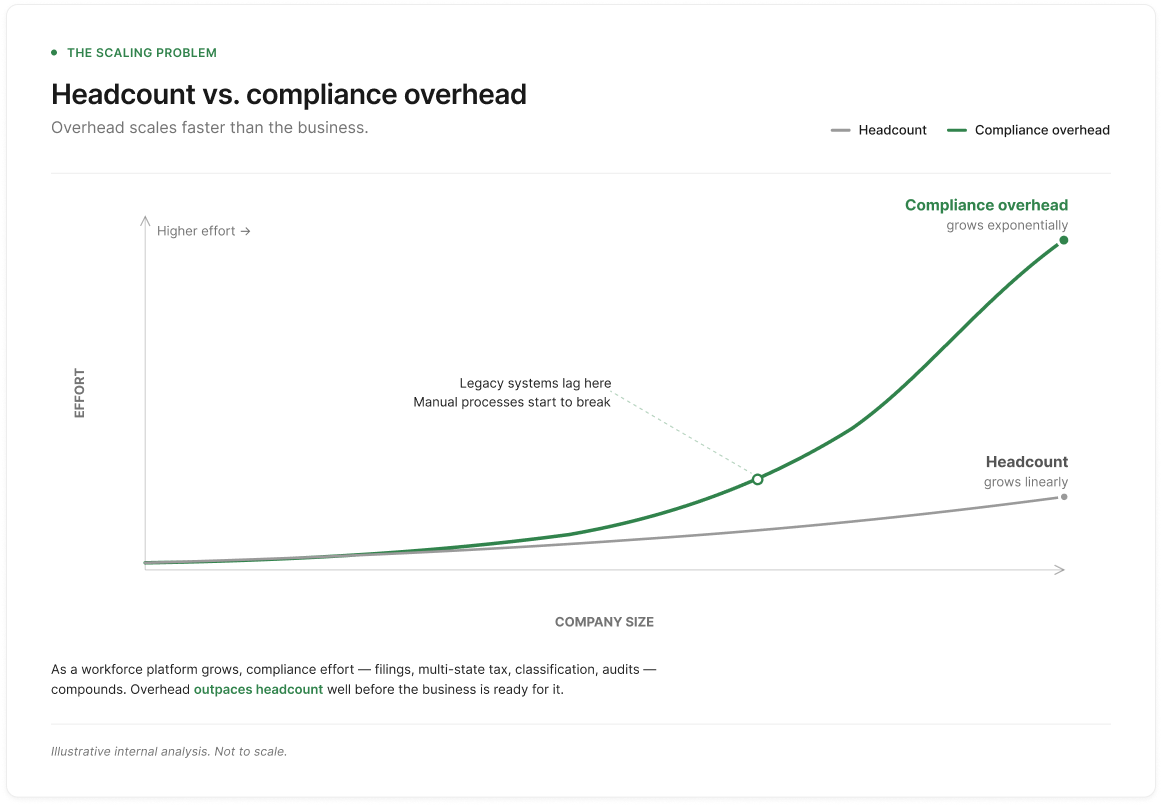
Operational overhead scales faster than the business. As companies grow, payroll complexity compounds. Data flows across onboarding systems, time-tracking tools, and payroll processors, which typically do not communicate well with each other. Teams spend hours reconciling discrepancies, cleaning data, and managing exceptions. Spreadsheets become the integration layer. Every manual step introduces the potential for error, and every error becomes a cost.
This becomes especially visible in industries that are dynamic and high-volume. In live production events, for example, companies like Backlit coordinate large crews working irregular hours, often across multiple roles, classifications, and pay rules within a single project. Historically, that meant stitching together time data, applying complex pay logic manually, and reconciling everything before payroll could even run.
Similarly, for Lawtrades, a platform that connects companies with legal talent on demand, operates in an environment where onboarding, work, pay, and billing are tightly coupled. They were scaling fast and managing payroll operations manually would have required additional headcount just to keep up. Instead, by unifying these workflows, they were able to reduce the number of people needed to operate payroll while continuing to grow, shifting effort away from manual coordination and toward higher-leverage work.
Worker experience becomes a competitive differentiator. For workers, payroll is not abstract. It is immediate and personal. A delayed or incorrect paycheck can have real financial consequences, especially for those living paycheck to paycheck. Confusing paystubs, lack of transparency, and limited access to earnings erode trust; 88% of employees said the way their company handles payroll reflects how much they are respected. Pay friction drives churn. Companies that provide faster, clearer, and more flexible pay experiences gain a structural advantage.
This is especially true in industries like healthcare, where work is shifting into more distributed, flexible models. Care is happening in homes and communities, supported by dynamic workforces that don’t fit the assumptions legacy payroll systems were built on.
Companies like NurseIO are a strong example of this shift. By enabling on-demand per diem nursing shifts within traditional healthcare systems, they’re helping providers operate with more flexibility while giving clinicians greater control over when and where they work. But supporting that kind of dynamic workforce requires infrastructure that can handle constantly changing schedules, locations, rates, and compliance requirements without creating friction for the worker experience.
When the system doesn’t fit the work, the burden falls on the worker. Organizations like ACE FMS, which support caregivers in government-funded programs, have historically operated in environments where workers had limited visibility into their pay and relied on administrative teams for basic information.
By modernizing their payroll infrastructure, they were able to give workers direct access to paystubs and tax documents within their existing platform, turning a fragmented experience into a simple, immediate one.
Strategic visibility disappears. Payroll is one of the richest sources of data in any organization. It reflects where work happens, how much it costs, and how it changes over time. But when that data is fragmented across systems or locked in static reports, it becomes unusable. Companies lose the ability to identify inefficiencies, manage risk, or make informed decisions about growth.
Could legacy payroll providers help businesses avoid these consequences by rebuilding payroll from the ground up? In theory, yes. In practice, no.
They are constrained by legacy infrastructure and the risk of disrupting systems that already process billions of dollars. Rebuilding isn’t just technically difficult, it’s an existential threat to revenue models these companies rely on.
Incumbents rarely rebuild the systems that made them successful, they extend them. In the meantime, new platforms emerge tailormade for the way modern work operates.
Today, payroll systems require people to do the work that makes payroll work. Tomorrow, payroll systems will just do the work. 24/7/365.
That is the fundamental shift: payroll moves from being something people operate to something systems execute.
Today, payroll systems process work after it happens. They rely on people to collect, clean, validate, and translate that work into pay. Payroll is episodic, company-centric, and dependent on manual coordination across systems.
Tomorrow, payroll systems understand work as it happens. Work becomes the source of truth, not a delayed input. Payroll moves from reacting to completed cycles to continuously interpreting work and translating it into pay.
What once required waiting for a paycheck, reviewing a static paystub, and trusting that everything was correct will be replaced by continuous visibility into earnings and direct interaction with a system that reflects work in real time.
The differences will be clear:
No more payroll runs. The concept of a fixed payroll cycle begins to disappear. Earnings are calculated continuously as work is completed. What used to be compressed into a bi-weekly process becomes a live, always-updating record of what has been earned.
No more reconciliation. Time, tax, and pay are no longer stitched together across disconnected systems. The need to export, clean, and re-import data disappears. The system operates on a single, unified source of truth, eliminating one of the most failure-prone parts of payroll.
Compliance is continuous. Instead of checking compliance after payroll is processed, rules are applied in real time. Tax logic adjusts based on where work happens. Classification is handled dynamically. Risk is surfaced before it becomes a problem, not after.
For RollCredits, a platform built for film and production crews, compliance isn’t a separate step, it’s embedded directly into how work is tracked and paid. Each production brings its own union rules, rate cards, and pay requirements, all of which must be applied as work happens. By structuring payroll around the realities of production, compliance becomes part of the workflow itself, not something reconciled at the end.
Payments become immediate. The gap between earning and receiving wages begins to collapse. Once work is completed and validated, payment is no longer a separate process. It is the natural output of a system that already understands what has been earned.
The system becomes proactive. Instead of reacting to errors, the system prevents them. It flags discrepancies, identifies missing information, and prompts action before issues cascade into payroll delays or compliance risk.
The role of people changes entirely. Instead of operating payroll, they oversee it. Instead of fixing problems, they manage exceptions. Instead of running processes, they rely on systems that run themselves.
When payroll is infrastructure, a new layer becomes possible: AI. Today, what exists as “AI in payroll” is largely tools that sit on the surface; they are commonly used to answer questions, summarize reports, or help navigate systems.
That’s because AI is only as powerful as the infrastructure it operates on. When data is fragmented across systems, workflows are disconnected, and compliance logic is applied after the fact, AI has no reliable foundation to act on.
It can generate suggestions but it cannot execute with confidence. AI execution on legacy payroll infrastructure results in compounded errors, risk, and complexity. You cannot delegate execution to agents when agents cannot access the right data, doesn’t include the right tools, and the system itself cannot guarantee correctness.
With modern payroll infrastructure, AI executes. Instead of humans coordinating workflows across disconnected systems, AI agents operate directly on top of payroll infrastructure: triggering actions, applying rules, resolving issues, and completing tasks end to end.
In this model, onboarding, time, pay, compliance, and billing exist within a single ecosystem. Data is real-time, structured, and accessible and rules are embedded, not applied after the fact.
The progress is cumulative, every step primes the next. At first, agents execute requests: running payroll, onboarding workers, and resolving issues when prompted.
Then, they become more proactive: identifying anomalies, flagging risks, and surfacing actions before problems occur. Eventually, they become autonomous: executing workflows end to end, resolving issues without human intervention, and continuously improving operations over time.
AI alone won’t fix payroll, it needs infrastructure. AI just makes the difference between legacy and modern infrastructure impossible to ignore.
The impact of a modern payroll system will extend far beyond payroll itself.
This is not just a better way to run back-office operations, it is a fundamental shift in how companies hire, scale, and compete. Most importantly, it’s a much needed upgrade to how workers experience getting paid.
Making predictions is more of an art than a science but here are some changes we can expect to precipitate from or run in parallel with this modernization:
Labor markets will become more fluid. When pay becomes faster, more transparent, and more reliable, participation increases. Workers are more willing to take on shifts, move between roles, and engage with new platforms when the path from work to pay is clear and immediate. Over time, this increases labor supply, fill rates, and allows companies to operate with greater flexibility.
More workers will get better payroll. More workforce platforms will be created and more vertical SaaS companies will choose to build payroll into their products because the infrastructure behind work will be easier to build on. Embedded payroll lowers the barrier to support the full lifecycle of work, without becoming a payroll company. As more platforms can enter and scale, more workers will adopt these tools and have a faster, better experience with their pay.
Compliance will become embedded infrastructure. Today, compliance is treated as a layer on top of payroll—managed by teams, consultants, and retroactive checks. In a modern system, compliance is built in.This shifts compliance from a cost center to a capability, allowing companies to expand into new markets without rebuilding their operations each time.
Workforce platforms will scale differently. The operational limits that once constrained growth begin to disappear. Companies no longer need to add headcount to manage payroll complexity as they expand. New markets, new worker types, and new business lines can be supported by the same underlying system. Growth becomes less about managing operations and more about capturing opportunity.
Worker expectations will permanently shift. Once workers experience real-time visibility, faster access to earnings, and clear, transparent pay, they will not go back. What feels like a differentiator today becomes the baseline tomorrow. Companies that fail to meet these expectations will struggle to attract and retain talent, especially in competitive labor markets.
Payroll data becomes a strategic advantage. When payroll operates in real time, it becomes one of the most valuable data layers in a business. Companies gain continuous insight into labor costs, workforce dynamics, and operational risk. Decisions that were once reactive become proactive. Strategy becomes grounded in real-time understanding, not delayed reporting.
At Zeal, we believe the future of payroll will be built on a fundamentally different foundation.
Over the past several years, we’ve invested in building that foundation from the ground up: a native tax and compliance engine, real-time APIs, embeddable components, white-label apps, and a unified system that connects onboarding, pay, and billing into a single layer of infrastructure. We’ve focused on what matters most—structured, real-time data, embedded compliance, and systems that can actually execute the work required to pay people correctly.
Because without that foundation, none of what comes next is possible. This is about redefining how work becomes pay.
Payroll is not a report, a process, or a scheduled event. It is a continuous system that sits at the center of how modern businesses operate. And for the first time, we have the technology to build it that way.
Share this:


.avif)
Co-founder & CEO


Kirti Shenoy is the CEO and Co-Founder of Zeal, a leading staffing operations platform that makes it faster, easier, and better for staffing companies to onboard, pay, and bill. Under her leadership, Zeal has raised over $30 million from investors like Spark Capital and Y Combinator. Kirti also serves on the American Payroll Association's Digital Payments Committee, where she works with policymakers on innovative initiatives such as EWA and Digital Payment legislation. Prior to Zeal, Kirti developed white-labeled banking products at BankMobile.


Zeal is a financial technology company, not an FDIC insured depository institution. Banking services provided by Bangor Savings Bank, Member FDIC. FDIC insurance coverage protects against the failure of an FDIC insured depository institution. Pass-through FDIC insurance coverage is subject to certain conditions.
Mastercard® Debit Card is issued by Bangor Savings Bank, Member FDIC, pursuant to license by Mastercard International Incorporated. Mastercard is a registered trademark, and the circle design is a trademark of Mastercard International Incorporated. Spend anywhere Mastercard is accepted.
